


Rupert Neve Designs 543 | VCA Compressor / Limiter

🚚
Standard delivery
Available immediately
Versandkostenfrei ab 50 €
🏷️Rupert Neve Designs💰Earn 768 Gear Coins
🔢 SKU: 23515 📋


  • VCA Compressor
  • Feed-Forward & Feed-Back
  • RMS & Peak Detection
  • Sidechain highpass filter
Read more

Original price was: 839,49€.Current price is: 768,90€.

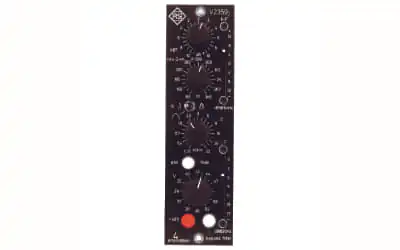
The Rupert Neve Designs 543 features a fully controllable compressor limiter with feed-forward/backward, peak/RMS detection and an integrated side-chain high-pass filter. With its unrivaled heritage and an enormous range of features, the 543 offers an astonishing degree of flexibility and precision.

  • VCA compressor and limiter
  • Feed-Forward & Feed-Backward
  • RMS & Peak Detection
  • Sidechain high-pass filter at 250 Hz
  • Link for two devices
  • Attack: 20ms – 75ms
  • Release: 100ms to 2500ms
  • Ratio: 1.1:1 to 40:1
  • Signal-to-noise ratio: -98dB (unity gain)
  • Output: 22dBu
  • Power consumption: 125 mA

VCA COMPRESSOR

Every compressor has a gain control element in its circuit that generally determines the “sound” of the compressor. Some compressors use tubes, some FETs, some light-dependent resistors, some a diode bridge – but in the 543 a VCA (Voltage Controlled Amplifier / Attenuator) is used to control the amplification of the signal.

Unlike a diode bridge design like our 535 compressor, which adds a thick, very colorful tone to the source, the 543 uses a very precise, low-noise and low-distortion VCA. This provides an immense amount of dynamic control and subtle warmth without necessarily leaving a heavy sonic imprint on your tracks or mixes.

THRESHOLD
Sets the level at which the compressor starts to react, from -30 dB to +20 dB. When the control is fully turned up, compression is minimal or non-existent. As the knob is turned counterclockwise, it becomes more sensitive and tends to reduce gain more (which may not be intuitive to some).

RATIO
Determines the “gradient” of the compression from 1.1:1 (minimum) to 40:1 (maximum). For example, if 3:1 is set and the input signal increases by 3 dB, the output signal only increases by 1 dB. In general, low ratios may not affect the music as much as high ratios, but high ratios may be more useful to minimize clipping and OL lights in the recorder.

COMP INPUT
Switches on the compressor section of the device.

F/F + F/B
These are two very different compressor modes, FEED FORWARD and FEED BACK. The F/B mode (key in) usually sounds softer and more natural and is quicker to set up. The F/F mode can be more useful when it comes to shaping the envelope of the sound and creating more bounce and pump in time with the song, if that is the goal.

GAIN
Continuously adjustable from -6 dB to +20 dB.

ATTACK
This sets how quickly the compressor reacts and starts attenuating. Infinitely adjustable from 20mS to 75mS.

RELEASE
This sets how quickly the compressor returns to zero after attenuation. Engineers generally use slower release times if the intention is to minimize an obvious compressor effect or gain change. Infinitely adjustable from 100mS to 2.5 seconds.

RMS/PEAK
With this setting, the compressor reacts not only to the RMS level of the audio signal, but also to the PEAK level. RMS (Root Mean Squared) circuits are considered better suited to mimic the way the ears perceive apparent loudness, while Peak circuits tend to respond directly to the waveform voltage, which is more suitable for avoiding clipping and maximizing levels.

SIDECHAIN HPF
Here, a high-pass filter set to 250 Hz is fed into the circuit that the compressor uses to determine the level. Note that the rest of the circuit and output will not filter out the low tones – this only determines the part of the signal that is affected by the compressor. This is very useful if you want the low frequencies to remain unaffected while the mids and highs continue to be compressed.

LINK
If the 500 series rack has a link bus, this can be used to connect the reduction of two 543 units with each other.

FEED BACK & FEED FORWARD

This switch changes the point in the signal path at which the VCA control voltage is tapped: either before the VCA (feed-forward) or after the VCA (feed-back).

In most of Mr. Neve’s early designs, feedback detection was an essential part of the musical dynamics. However, the nature of a feedback compressor limits the response time of the compression circuit, as the control voltage has already passed through the VCA itself. To provide faster, technically more precise response times, feed-forward detection has also been implemented in the 543: With the FF/FB switch, both classic and modern VCA responses are available.

FEED BACK & FEED FORWARD

Another very useful feature of the 543 is the Peak/RMS mode, which allows the VCA to respond to both RMS (Root Mean Square) and peak levels. RMS circuits are considered better suited to mimic the way the ears perceive apparent loudness, while peak circuits tend to respond directly to the waveform voltage, which can help to avoid clipping and maximize levels.

In the case of this particular circuit, Peak mode uses a combination of both methods to get the best of both worlds and avoid the disadvantages of each method on its own.

Compressor Type

VCA

Tube

No

Format

500 Series

Channels

Mono

Recall - Remote

No

500s Slots

1

Signal Level

Line Level

primary area of application

Mixing

Sends

No

Returns

No

Sidechain Int

Yes

Sidechain Ext

No

Mix Dry/Wet

No

Stepped potentiometers

Yes

Product safety

Manufacturer information

Rupert Neve Designs, LLC.
PO BOX 1969
Wimberley, TX 78676
USA

+1 (512) 847-3013

Person responsible for the EU

Mega Audio GmbH
Feldborn 3
55444 Waldlaubersheim
Germany
+49 6707 914 522

Safety instructions

Our offer is primarily aimed at commercial users who test and use products on their own responsibility for their professional use. Please note that safety-relevant information, instructions and symbols may be included in the supplied instructions for use. This is enclosed with the product and, if available, can also be downloaded in digital form from our website.

We recommend that you read the instructions for use carefully and check the product for safety and suitability for your intended use before use. If you require further information, please contact the manufacturer or the manufacturer's EU representative directly.

Reviews

There are no reviews yet

Only logged in customers who have purchased this product may leave a review.

Q & A

Ask a question
Rupert Neve Designs 543 | VCA Compressor / Limiter Rupert Neve Designs 543 | VCA Compressor / Limiter
Your question
* Question is required
Name
* Name is required
* Please tick the checkbox to proceed
There are no questions yet
My Cart
Wishlist
Recently Viewed
Categories
Select the fields to be shown. Others will be hidden. Drag and drop to rearrange the order.
  • Image
  • SKU
  • Rating
  • Price
  • Stock
  • Availability
  • Add to cart
  • Description
  • Weight
  • Dimensions
  • pa_abmessungen
  • Amp Class
  • No. of analogue outputs
  • No. of analogue inputs
  • Propagation speed
  • Degree of bending
  • Capsule
  • Channels
  • Color
  • Compressor Type
  • pa_conductor-resistance
  • Connections
  • Connector Brand
  • pa_connector-type
  • Conversion
  • pa_daempfung-bei-100-mhz
  • pa_daempfung-bei-500-mhz
  • pa_dauerbelastung
  • pa_durchmesser-isolierung
  • pa_durchmesser-leiter
  • Input impedance
  • EQ Type
  • Farad Core to Core
  • Farad Core to Screen
  • Format
  • Frequency bands
  • Overall diameter
  • Height (cm)
  • Impedance
  • Insulation
  • Jacket
  • Headphone output
  • pa_leiterquerschnitt
  • Length
  • Sample Rate
  • Max. resolution
  • Max. cable diameter
  • Max. Power
  • Microphone model
  • Number of microphones (sets)
  • Min. cable diameter
  • Module Position
  • Modular extension
  • Module size
  • Multicore
  • Patch modes
  • Phantom power
  • Number of poles
  • pa_preamp
  • Room correction
  • pa_resistance-insulation
  • Directional pattern
  • RMS Power
  • Tube-Socket
  • Tube-Type
  • pa_side-chain
  • Signal Level
  • Modification
  • Plug-in cycles
  • System
  • Transformer
  • Transmission protocols
  • Tube
  • Rack Units (RU)
  • Gold-plated / Silver-plated
  • Version
  • Conversion principle
  • Angle
Compare